MATT MOTTELArtist · Performer · ArchivistEarlier projects
Professional presentation / CUNY IT Conference / 2025
AI and the Archive
Designing with AI: Tools and Creative Practice
What is the context of content? A photograph carries a history before it becomes a prompt.
My presentation begins with the Syeus Mottel archive and The Image Is a Seed, then follows a photograph into a series of AI-generated variations. The original image remains visible. Changing the prompt changes the imagined scene, making the artist’s choices and the model’s departures available for discussion.
This is also a teaching method. Students work with archival photographs as source material, develop their own speculative narratives and examine how images acquire authority. Historical documentation and an imagined response can appear together while retaining their different purposes.
The talk asks how an archive can become a structure for gathering: a classroom, a shared investigation, a place where several people can bring different interpretations. Its ethical questions concern context, bias, human judgment and the risk of passing a generated scene off as historical evidence.
CUNY IT Conference / John Jay College of Criminal Justice / December 4, 2025 Matthew Mottel / Adjunct Professor, Brooklyn College Conference programme
selected excerpts / original slide numbers retained
Six slides from the presentation
The sequence keeps the historical photograph beside its speculative variations. Select a slide to enlarge it, or open its text below.
Slide 1 / the presentation and its connection to The Image Is a Seed.Read slide 1 / AI and the Archive
AI and the Archive
Designing with AI: Tools and Creative Practice
Matthew Mottel — Adjunct Professor, Brooklyn College
The Image is a Seed
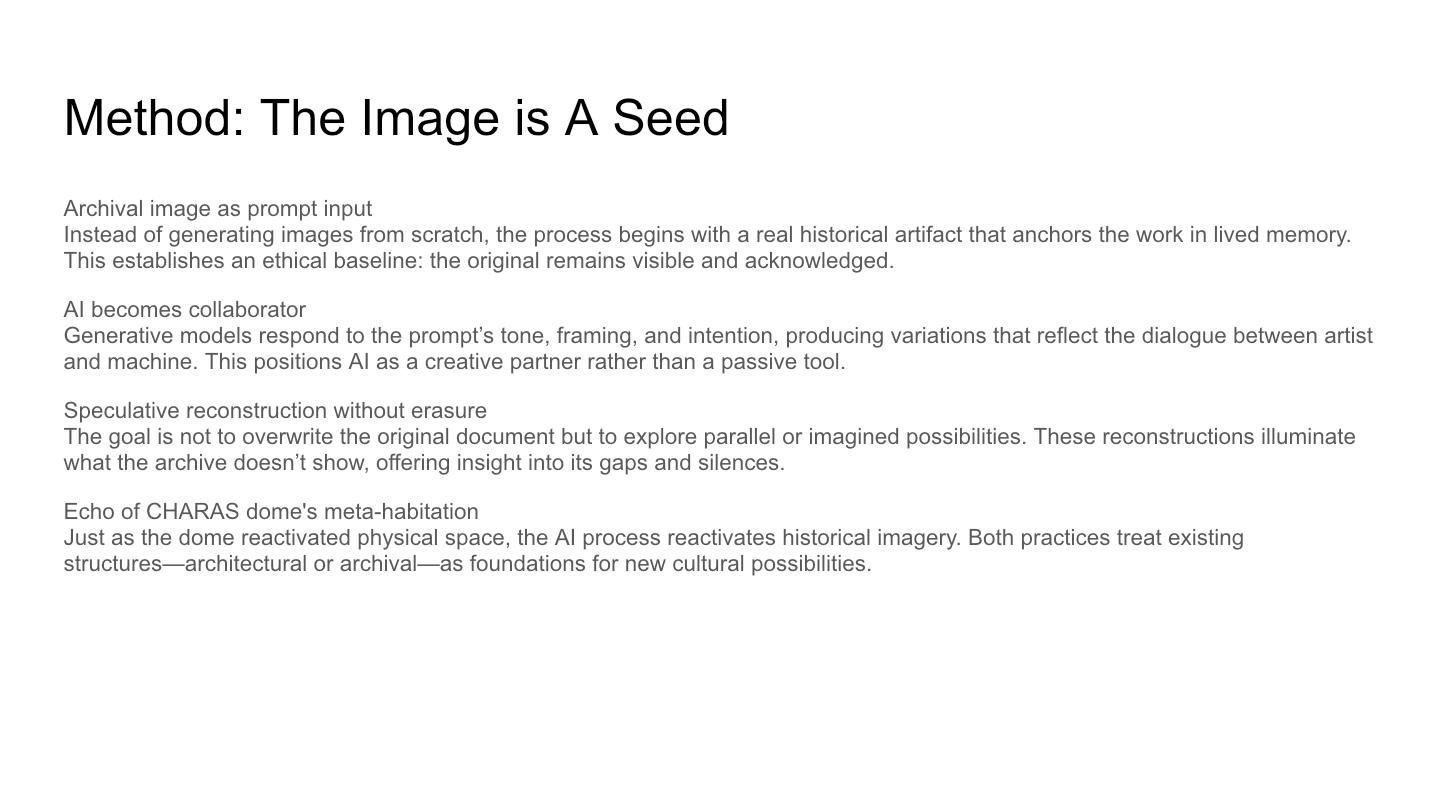
Slide 7 / the archival image anchors a process of interpretation and speculative reconstruction.Read slide 7 / Method: The Image is a Seed
Method: The Image is A Seed
Archival image as prompt inputInstead of generating images from scratch, the process begins with a real historical artifact that anchors the work in lived memory. This establishes an ethical baseline: the original remains visible and acknowledged.
AI becomes collaboratorGenerative models respond to the prompt’s tone, framing, and intention, producing variations that reflect the dialogue between artist and machine. This positions AI as a creative partner rather than a passive tool.
Speculative reconstruction without erasureThe goal is not to overwrite the original document but to explore parallel or imagined possibilities. These reconstructions illuminate what the archive doesn’t show, offering insight into its gaps and silences.
Echo of CHARAS dome's meta-habitationJust as the dome reactivated physical space, the AI process reactivates historical imagery. Both practices treat existing structures—architectural or archival—as foundations for new cultural possibilities.
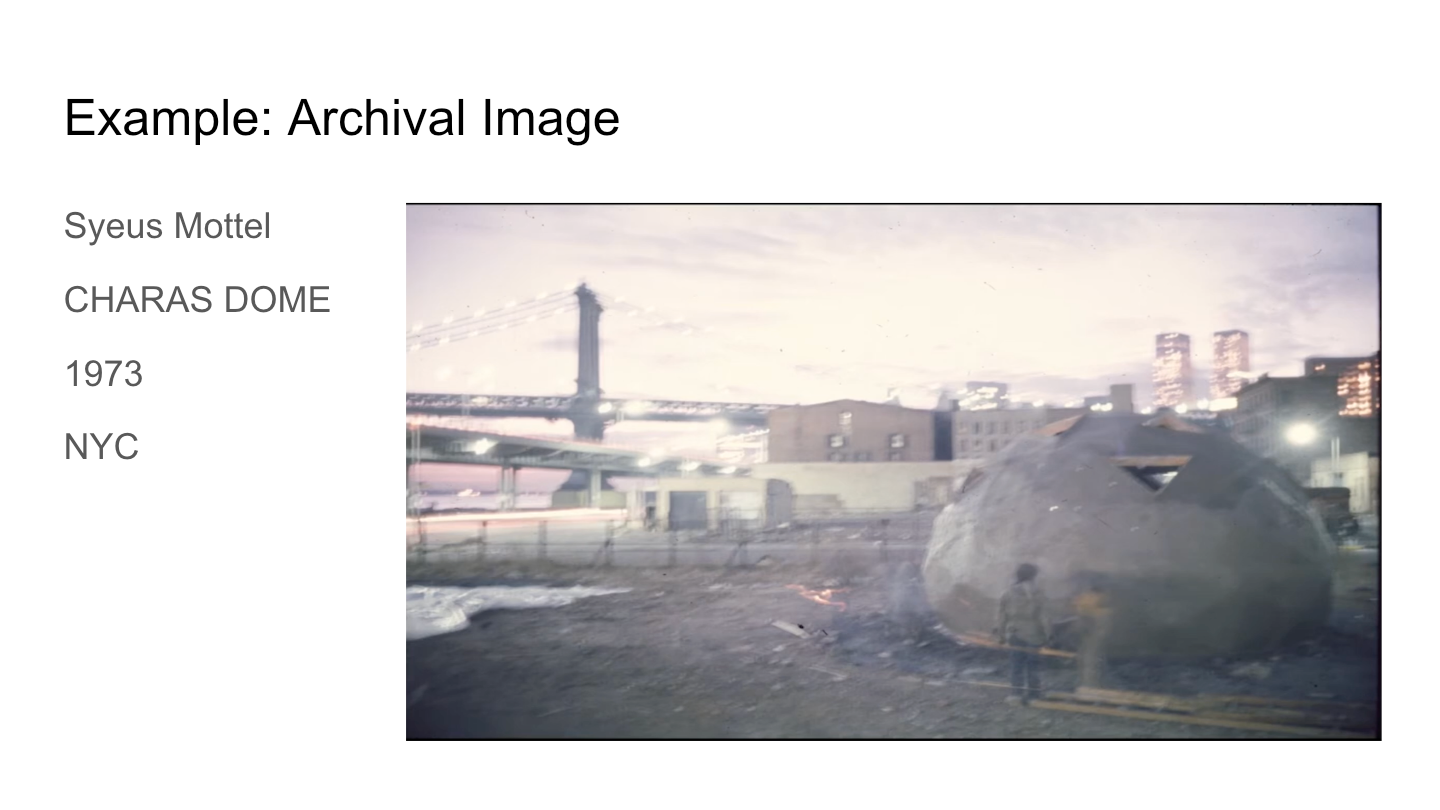
Slide 8 / Syeus Mottel’s photograph of the CHARAS dome, identified in the presentation as 1973, New York City. Historical photograph.Read slide 8 / Example: Archival Image
Example: Archival Image
Syeus Mottel
CHARAS DOME
1973
NYC
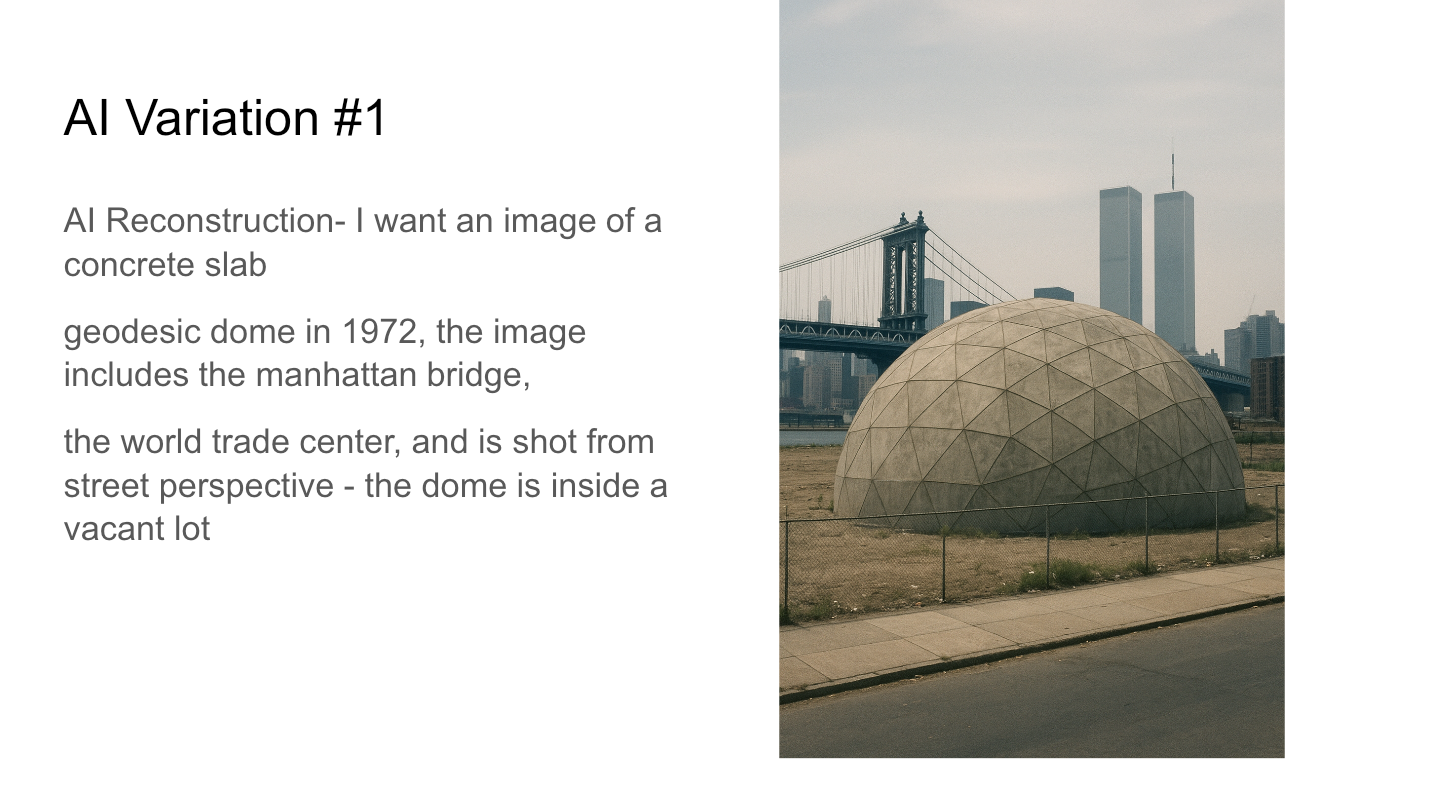
Slide 9 / an AI-generated reconstruction made in response to a prompt. Speculative image; not historical documentation.Read slide 9 / AI Variation #1
AI Variation #1
AI Reconstruction- I want an image of a concrete slab
geodesic dome in 1972, the image includes the manhattan bridge,
the world trade center, and is shot from street perspective - the dome is inside a vacant lot
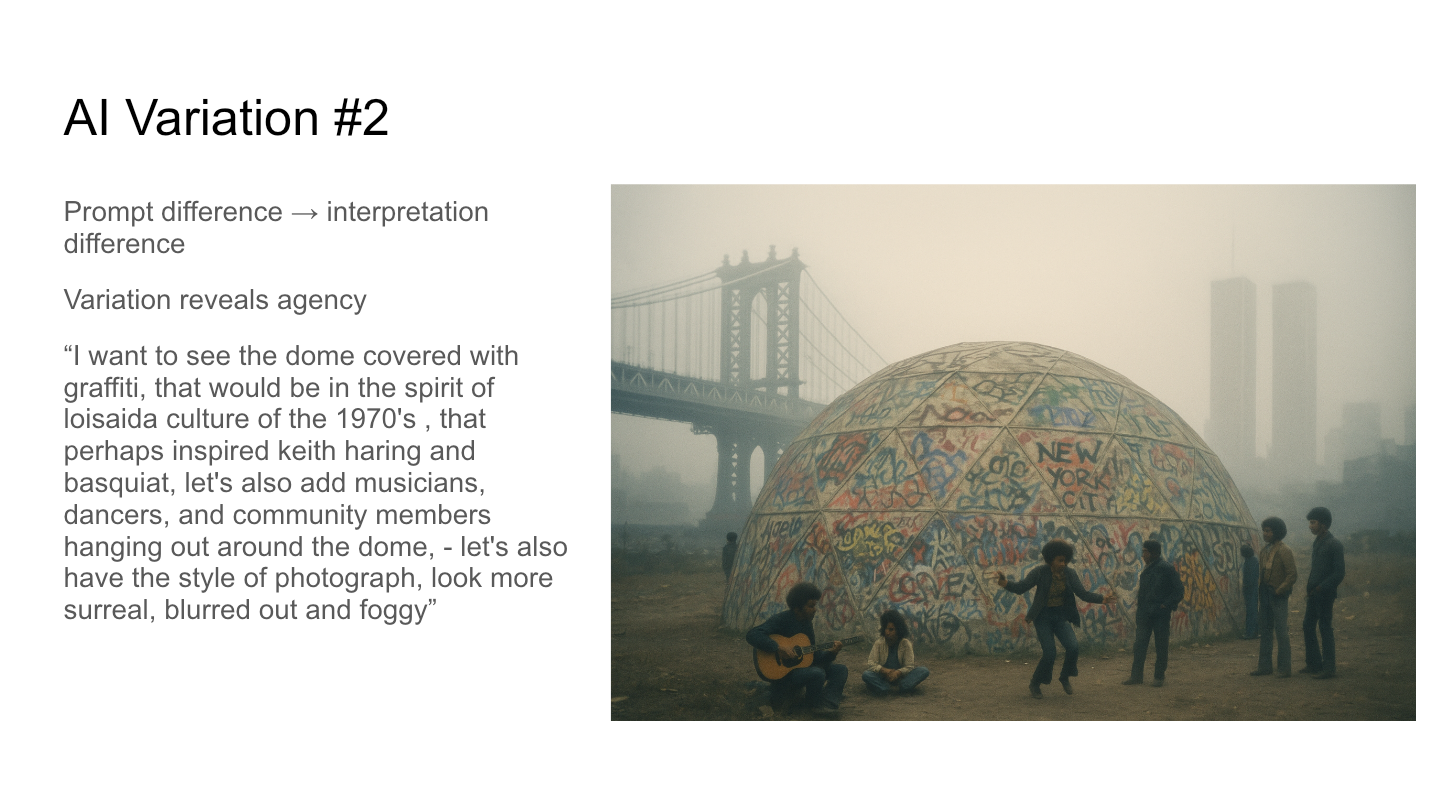
Slide 10 / a changed prompt introduces graffiti, people and a different atmosphere. AI-generated speculative image; not historical documentation.Read slide 10 / AI Variation #2
AI Variation #2
Prompt difference → interpretation difference
Variation reveals agency
“I want to see the dome covered with graffiti, that would be in the spirit of loisaida culture of the 1970's , that perhaps inspired keith haring and basquiat, let's also add musicians, dancers, and community members hanging out around the dome, - let's also have the style of photograph, look more surreal, blurred out and foggy”
Slide 18 / retain context, avoid false historicity, and leave interpretation to human judgment.Read slide 18 / Ethics & Integrity
Ethics & Integrity
Preserve Original Context Archival materials retain meaning only when their original context is honored. Context allows us to understand why and how records were created.
Avoid False Historicity We must resist projecting a sanitized or imagined past onto archival materials. Misrepresentation erases the complexity and contradictions of history.
AI Reveals Gaps Rather Than Filling Them AI can highlight absences, silences, and patterns in archives without imposing false narratives. It makes visible what is missing, prompting critical inquiry.
Treat AI Like a Structure for Gathering AI functions as a tool for organizing and connecting materials, not as an authoritative interpreter. It provides scaffolding for exploration, leaving meaning-making to human judgment.
related teaching project
From presentation to classroom
In Image is a Seed: Student Addition, students choose archival photographs, make images in response and build a narrative through video and sound. The project makes the questions in this presentation available through the act of making a film.